Diagram: The five PRISM stacks, Research on top and Evidence as the foundation
01The platform
What PRISM is built from.
PRISM has five stacks, each with one job. Every part is marked with how ready it is.
In use Used in our projects today
Prototype Working, being improved
In development Being built
Target The goal
Stack 01 / 05Research
Stack 01 / 05
Research stack
Out of millions of possible mixes, which are worth making?
PRISM ranks a short list of candidates and says how sure it is about each. Physics simulations throw out what cannot work before any powder is weighed.
01
Knowledge graphPapers, patents and lab data, linked, each with its source.
Prototype
02
GeneratorSuggests a whole batch of promising recipes, not one best guess.
Prototype
03
Judges and trust meterSeveral models score each recipe. Where they disagree, the score counts for less.
Prototype
04
Exact checkThe promising recipes the models are unsure about get an exact quantum calculation.
Prototype
05
A window, not a pointA safe range that still works when powder and machine change.
Prototype
LimitIt cannot see what a real machine does to the alloy. The manufacturing stack checks that.
Stack 02 / 05
Harness stack
Who runs the work between the AI models?
The harness does. The AI models only make suggestions. The harness plans each round, runs the tools, scores the results and remembers what failed.
01
PlannerDecides what to try next, from the last results.
Prototype
02
PlaybooksWhat each round learned, failures included.
Prototype
03
Tool connectionsOne way in to simulations, lab instruments and factory data.
Prototype
04
ScorerScores every result against the requirement.
Prototype
05
Human sign-offAI suggests, engineers decide. Ideas without a source are rejected.
Prototype
LimitIt never makes the final call. A named engineer signs off what leaves the loop.
Stack 03 / 05
Autonomy stack
How do experiments stop being the slow part?
Robots do the repetitive steps, and people stay in charge. They weigh and heat, instruments measure on the spot, and the data goes straight back into the loop.
01
Recipe writerTurns an idea into steps a lab can run.
Prototype
02
Robot labRobot arms weigh powder and move samples through the furnace.
In development
03
Automatic measurementX-ray patterns on the spot, read by AI.
In development
04
ProbesOur own sensors, recording calibrated data at the machine.
In development
05
Machine controlSoftware drives the instruments, so the loop never waits.
In development
06
Field robotsThe same autonomy outside the lab, without GPS. For civil and defence use.
In development
LimitMost of this is still being built. The recipe writer works as a prototype today.
Stack 04 / 05
Manufacturing and test stack
Can it really be made? Does it hold up?
Only a real test can tell. Most materials designed on a computer never get past the recipe. We melt the best ideas, mill them down, make powder and print them, then test them.
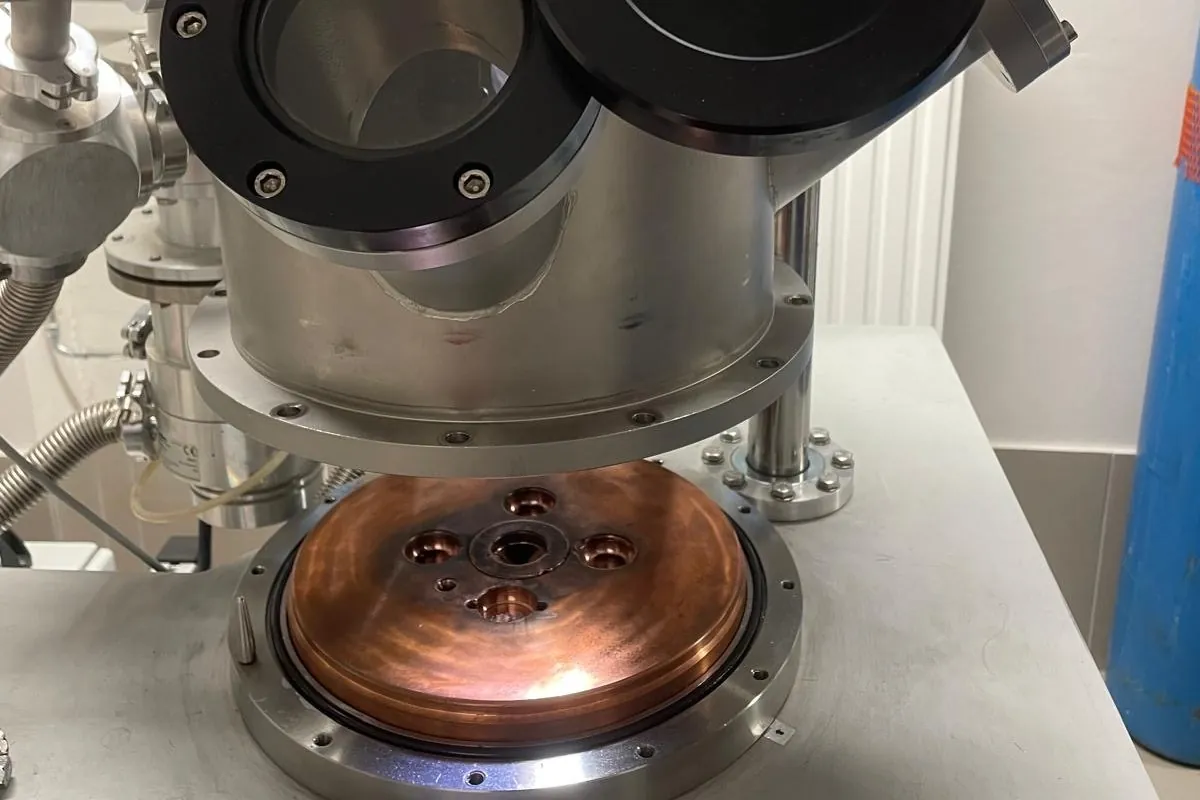
The vacuum-arc furnace, open.
01
Melting and powderMelted in a vacuum-arc furnace, milled down and made into powder.
In use
02
Printability checkCan it be 3D-printed? Checked before any build starts.
Prototype
03
Metal 3D printingLaser powder bed fusion, first at Fraunhofer IAPT, then on Bimo Tech’s industrial machines, with the safe settings carried across. DED too.
In use
04
TestingDensity and inner structure first, then strength and heat.
In use
05
Certification fileThe evidence certification needs, from test sample to real part.
Target
LimitA test sample is not a finished part. Certification is our goal; we do not claim it yet.
Stack 05 / 05
Evidence stack
Where did this result come from, and who may see it?
Every result records where it came from, who owns it and who may use it. Requirements, designs, samples, tests and decisions are linked, like a family tree.
01
TraceabilityEvery result records its inputs: data, code and model versions.
In use
02
Linked recordsRequirement to decision, linked instead of scattered in files.
Prototype
03
Data rightsEach piece of data carries its owner and its allowed uses.
In development
04
Controlled sharingNothing is shared by accident. Every release is signed.
In development
05
Export controlExport rules on every deliverable today; automatic checks next.
In use
LimitTracing and export labels work today. Automatic enforcement is being built.
Project SPARK: eight candidate alloys narrowed to two, made as real metal.
PRISM Alpha, a full ESA project in the launcher programme FLPP, kicked off in July 2026.
Our first privately funded project, for PFAS‑free polymers, is signed.
PRISM won the AI special prize (KI‑Sonderpreis) at Hessen Ideen 2026.
PRISM received a FIRST! Simulation & Intelligence award at the ESA FLPP Autumn Session in Paris on 14 October 2026.
Still to prove
One full loop, from requirement to test results. That is PRISM Alpha’s job.
Robots making samples and software driving the instruments, on a real line.
A material taken from test sample to real part, with the evidence certification needs.
Materials programmes
The loop, taken to new kinds of material.
ActiveRefractory alloys
ContractedPFAS‑free polymers
NextPolymers and bio-based materials
Supply-chain intelligence
The same tools, used to see how a change at one supplier spreads.
InternalSupply risk
PrototypeMarket signals
ExploratoryProgramme risk
NextEarly warnings
How a disruption spreads
Pick the supplier where trouble starts, then watch it spread to the programmes that depend on it.
Diagram: Illustrative supply network from mines to programmes, with feedback from the programmes back to the mines.
Chance each programme is hit
Launcher24%
Jet engine20%
Fusion reactor16%
Impact peaks after
31 days
1 in 20 disruptions reach
49+ events
We use the same model to forecast how a material degrades: sensor readings become events, and the model predicts when a part will fail.
Illustrative
The network and its rates are made up; the chances are computed exactly from the model, a Hawkes process. Our methods are adapted from Okawa et al., “Dynamic Hawkes Processes for Discovering Time-evolving Communities’ States behind Diffusion Processes”, KDD 2021, for supply chains, and from Repasky et al., “Modeling Discrete Coating Degradation Events via Hawkes Processes”, 2025, for degradation.
Whatever PRISM is used for, every claim keeps its source and says how sure it is.
Start
Tell us what your part must survive.
We’ll tell you what PRISM can find, and how we’d prove it.