01The method

PRISM chooses which experiments to run.

Real experiments are slow and expensive, so PRISM runs the ones that will teach us the most.

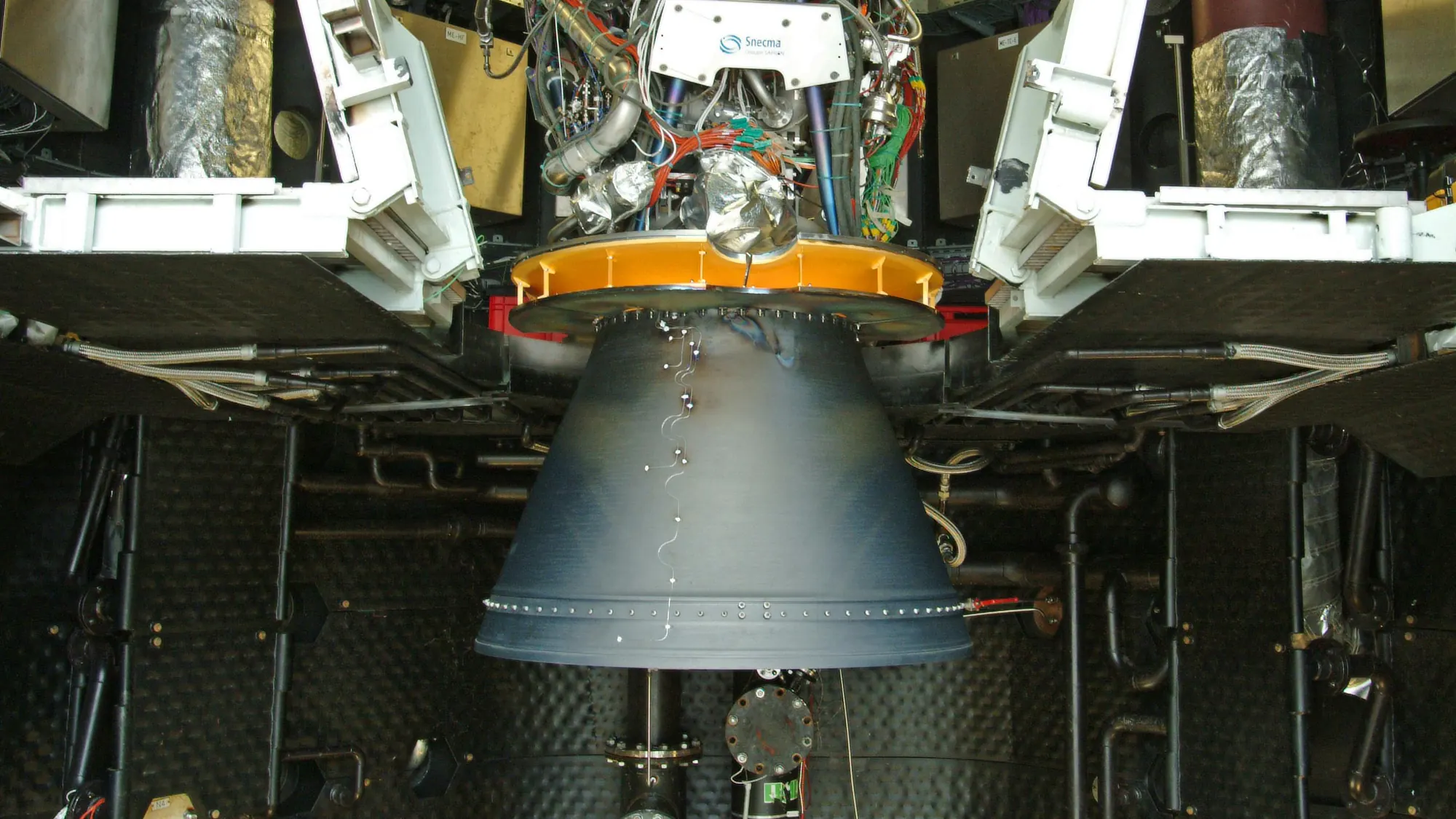
The Vinci upper-stage engine mounted in an altitude test stand: its dark nozzle hangs below a tangle of pipes and cables.
A real engine test takes months. Vinci, in an altitude test stand at DLR.

Exhibit A · The ladder

Cheap checks come first, expensive ones last.

Most ideas stop early, in a simulation that takes seconds, long before a test that takes weeks.

Diagram: The PRISM ladder: a fast AI simulation, an exact quantum calculation, phase diagrams, a printability check, then make and test. Each step costs more than the one before, and most ideas stop early. Counts are illustrative.

  1. 0 Is it stable at all?

    fast AI simulation · seconds

    48 in, 24 pass

  2. 1 Is the energy right?

    exact quantum calculation · hours

    24 in, 10 pass

  3. 2 What forms at each temperature?

    phase diagrams · minutes

    10 in, 5 pass

  4. 3 Can it be 3D-printed?

    printability check · seconds

    5 in, 2 pass

  5. 4 Does it meet the requirement?

    make and test · weeks

    2 in, 1 chosen

Illustrative

Drawn for this site. The counts show the shape, not real results. Times are typical per idea.
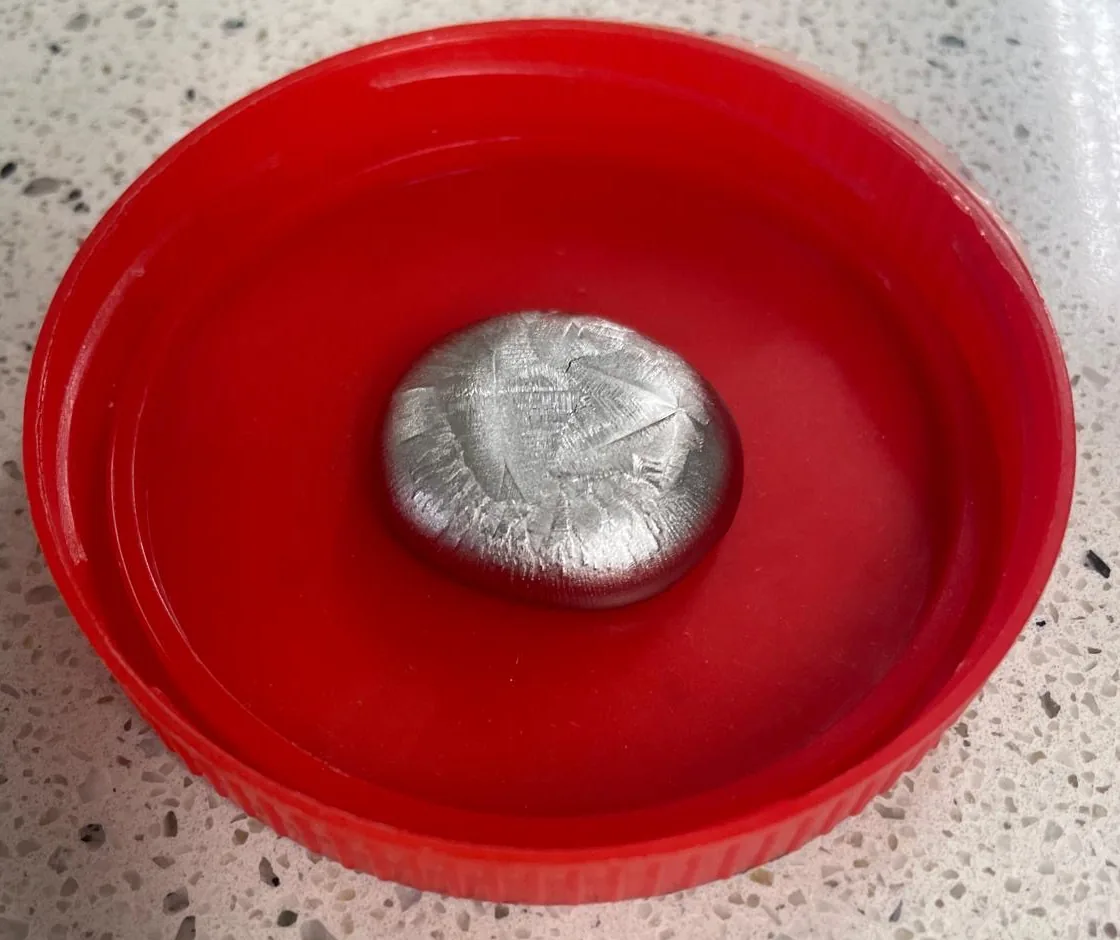
Exhibit B · Safe settings

We look for a safe range of settings.

Machines drift, so the recipe needs room to spare. Drag the dot: anywhere in the hatched area, the metal still comes out solid.

Illustrative

Boundaries follow standard scaling rules: lack of fusion with P/v, keyholing with P/√v, balling at high speed. Not measured data.

Energy density88 J/mm³

Inside the safe range

The metal melts into the layer below and comes out solid.

Safe: still works if power drifts 10 % and speed 8 %.

Exhibit C · Smart experiments

Each experiment is chosen for what it will teach us.

PRISM tests where the model is least sure, close to the best answer. Press Run to watch the uncertainty shrink.

19
measurements for NIST’s CAMEO system to find the best material
177
points on the full map, most of which it never had to measure
Sources

Kusne et al., Nature Communications 11, 5966 (2020): about 10 hours instead of more than 90. The demo is a real learning loop (a Gaussian process) on a test function, not material data.

Diagram: Active learning on a synthetic function: 2 of 177 points measured.

Measured 2 of 177

Exhibit D · Reuse

Only the modules change from one material to the next.

The core stays the same. That is how one platform moves from alloys to polymers.

The core · stays the same

  • Planner and playbooks
  • Idea generator
  • Scorer
  • Knowledge graph and traceability
  • Printability check
  • Evidence file

The same core, from one project to the next.

Changes with each material

Requirement

Where it works, how hot, and the alloy to beat

Physics

Fast AI simulations, exact quantum calculations and phase diagrams

Scored on

Stability, resistance to oxidation, and printability

Tests

Density, inner structure and heat tests

02How PRISM choosesPrototype

Which recipes are worth making?

The AI proposes and scores recipes, and says where it is unsure. Exact physics and real tests have the last word.

Diagram: How PRISM chooses: a generator proposes recipes in a design space of three elements. Several models score each one, and a halo shows how much they disagree. The promising but uncertain ones get an exact check, recipes that are hard to print drop out, and a safe window is chosen. Test results retrain the models.

Illustrative

Drawn for this site. The recipes, scores and window show how it works; they are not project data.

  1. 01

    Propose

    A generator suggests a whole batch of recipes: many good ones, not one best guess.

  2. 02

    Judge

    Several independent models score each recipe. Where they disagree, we trust the score less.

  3. 03

    Check exactly

    The promising recipes the models are unsure about get an exact quantum calculation.

  4. 04

    Can it be printed?

    Before any metal is made, we check that it will print, using Fraunhofer IAPT’s process data.

  5. 05

    A window, not a point

    We send a safe range, not a single point. A range still works when the machine changes.

  6. 06

    Test, then learn

    Every test result goes back in and retrains the models for the next round.

A language model reads the papers and cites its sources. It never judges the physics.

03Open research

Forager: a fruit fly’s brain, searching for new alloys.

Our open research project. The wiring map of a fruit fly’s brain steers an AI that suggests high-melting alloys.

164,506
brain cells in the wiring map that steers the search
5 checks
from a quick estimate to full quantum calculations
240+
experiments in the public log, each with its prediction written first

Diagram: A known answer, checked: for a 50/50 mix of molybdenum and tantalum, Forager gives 1149 plus or minus 114 kelvin, inside the pass band of 500 to 2600 kelvin agreed before the run. The published value is 2020 kelvin.

Before a check is trusted, it has to reproduce a known answer.

Sources

Forager, experiment E242; published value from Kim and Widom, Phys. Rev. Materials 7, 063803 (2023), with Forager’s own error rule applied to it.

Forager

Forager uses only public data. It is separate from the projects above.

04Proof

We keep the evidence for every result.

Each record shows where it came from and who may see it. Switch the viewer to see what each partner sees.

Viewing as

Owns the requirement. Opens 5 of 8 records.

Customer AYou

Release R-019Release R-019Signed by Customer A. For manufacture only.

Partner B

Compute onlyCompute onlySoftware reads the raw data. No person does.

Mirdyne

Release R-044Release R-044Aggregate properties only.

Customer AYou

  • PrivateStays with the company that made it.
  • ComputableSoftware may use it. No person reads it.
  • ReleasedShared with named partners, signed.
  • PublicPublished on purpose, never by default.
Illustrative

Made-up parties and records, not customer data. Tracing and export labels work today; automatic enforcement of sharing rules is being built.

Rules PRISM follows

  1. 01Anything made from data keeps the strictest rules of its inputs.
  2. 02Training AI on a partner’s data needs its own permission.
  3. 03Export rules travel with the data.
  4. 04Partners can leave at any time and take their data with them.

A published example

What a complete record looks like.

In 2020, NIST’s AI system CAMEO found a better memory material and recorded every step. We keep the same kind of record for every result.

  1. 01 · The question

    Which mix of germanium, antimony and tellurium changes most between glass and crystal?

  2. 02 · The options

    177 different mixes, made side by side on one 3-inch wafer.

  3. 03 · What was known

    Light scans of every spot, as glass and as crystal, taken before the run.

  4. 04 · The measurements

    19 rounds. In each, CAMEO picked one spot to X-ray and learned from the result.

  5. 05 · The answer

    Ge₄Sb₆Te₇, found in round 19. About three times the contrast of the best-known material.

  6. 06 · The proof

    Checked two more ways: under an electron microscope, and in a working device.

Sources

Kusne et al., Nature Communications 11, 5966 (2020); NIST news release, 24 November 2020. CAMEO is the work of NIST and its partners, not ours. We show it because it is the clearest published example of a complete record.

What stays yours

A finished part does not give away how it was made.

A cast alloy button with a crystalline surface, resting in a red lid on a lab bench.
An alloy button, as cast.

Diagram: What testing a part reveals: what it is made of, its trace gases and its inner structure. What stays with the owner: the safe settings, the failures, the history and the proof.

What a part gives away

  • What it is made ofStandard lab analysis
  • Trace gasesOxygen, nitrogen and carbon
  • Its inner structureX-ray and electron microscopes
  • Clues about how it was madeHints, not the recipe

What stays with its owner

  • The safe settingsWhat still works when things vary
  • The failuresEvery idea that did not work, and why
  • The historyFrom requirement to decision
  • The proofTest results, and the ability to make it again

Patent filings on PRISM’s methods are in progress.

Start

Tell us what your part must survive.

We’ll tell you what PRISM can find, and how we’d prove it.